Home › Blog › Polyaspartic vs Polyurethane for Flake Floors: The Ultimate Comparison Guide
When we are trying to make a comparison, we are often looking for an overview that provides us with the clear reason for choosing one
product or another. However when it comes to comparing polyaspartics and polyurethanes, the overview is not as useful and we need to dive
into some details. The best resin for your application will be completely clear when you understand speed of cure, durability, value,
weathering, solvent risks, hot tyre pickup and tyre staining.
Note - The video is based on the same topics but is likely to include more information and examples.
Before we look at what "better" might mean, it is interesting to read the answers provided based on how you ask the
question of your favourite search engine.
For example...
Q - why is polyaspartic better than polyurethane for garages?
A - "Polyaspartic is better than polyurethane for garages because it offers superior durability, faster curing
times, and better UV resistance, making it ideal for high-traffic areas and ensuring a long-lasting finish. Additionally, polyaspartic
coatings can be applied in a wider range of temperatures, enhancing their versatility for garage applications."
Referenced AI citations - floortechconcretecoatings and duluxavista
Q - why is polyurethane better than polyaspartic for garages?
A - "Polyurethane is often chosen over
polyaspartic for garages when chemical resistance and budget are priorities, as it is less expensive and excels in resisting harsh
solvents and acids, making it ideal for auto shops or labs."
Referenced AI citations - floortechconcretecoatings and strongholdfloors
So the answer you get will very much depend on where the information is sourced from and the bias of your question. It is also
interesting to look into the cited references and learn where the AI summary originated from. Note that in this particular search, it appears that there are opposing responses from the same website.
The following summary table was also provided as part of the AI Overview response.
Summary Table comparing polyaspartics to polyurethanes.
| Polyurethanes |
Polyaspartics |
|
| Cost | Lower | Higher |
| Chemical Resistance | Excellent | Good |
| Flexibility | More flexible | Less flexible |
| Curing Time | Longer | Faster |
| Ideal Use | Auto shops, labs | Residential garages |
There will be many ways to define "better". To some a cheaper product is better. To others a fast cure time is better. To a third
person, they like a better finish. So it is wise to look at what might be better for the particular application than asking a general
overview question.
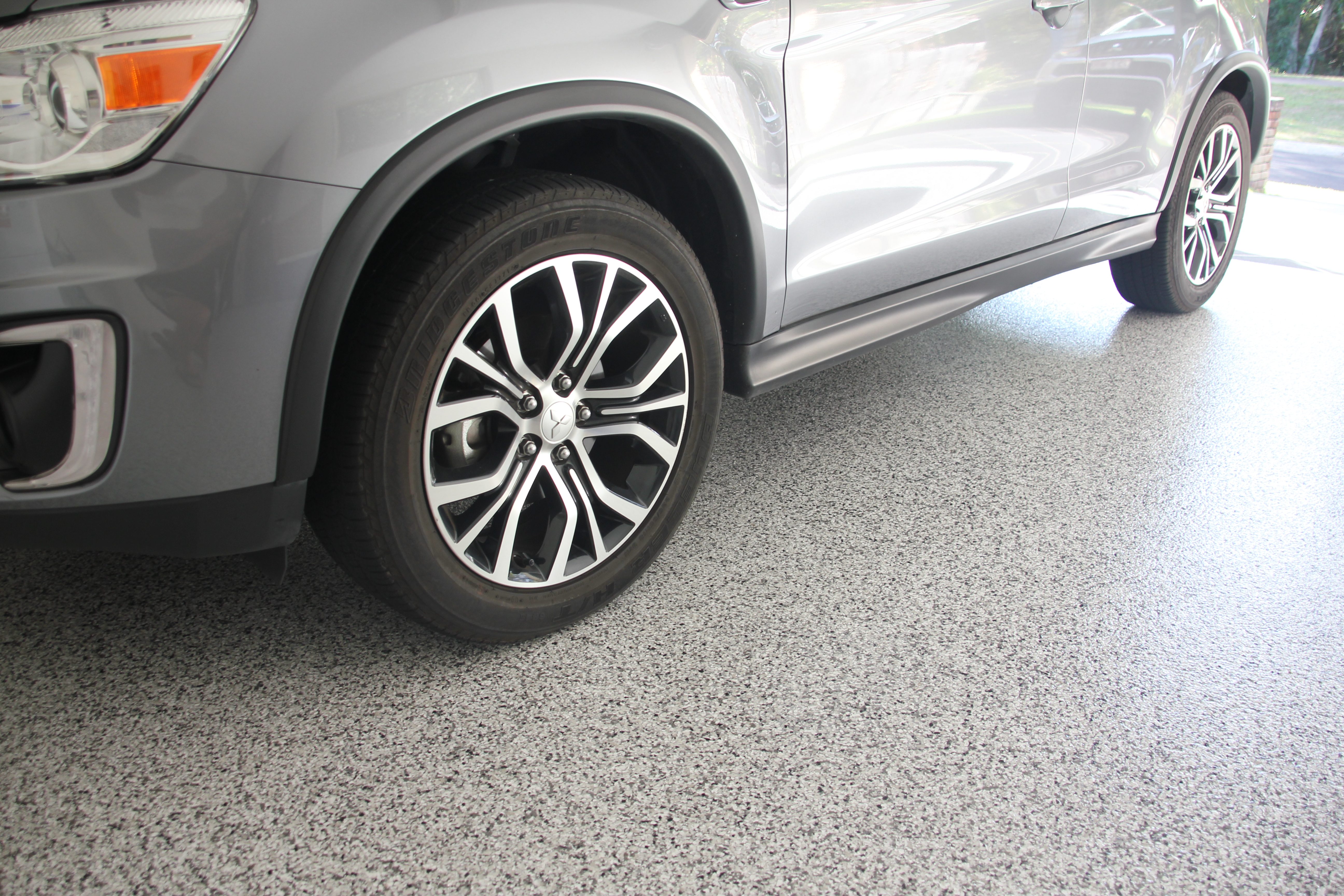
Image - showing a Resin Vinyl flake floor using Ezypoly 1K moisture cured solventless polyurethane.
The fundamental difference why people choose Polyaspatics over Polyurethanes is speed of initial cure. Faster initial
cure, in theory, enables faster return to service for light foot traffic. The key point to understand is initial cure is faster
but full cure still happens over a similar timeframe as polyurethanes. So depending on the application, it may not be a faster return to
service because the primary use of the floor may require full cure before being used. As an example, in a garage floor scenario it
might be advantageous to walk on the floor in a few hours but if you can't park your car on the floor for 5 - 7 days, then there is
no practical advantage in using a polyaspartic.
Resins tend to go through different stages of curing. We tend to use the term "curing" because the crosslinking of the resins is not due to anything drying, like you might see with a paint.
Once a two component resin is mixed, it starts to crosslink.
The phases of cure are:-
Potlife - This is the time you can keep the mixed product in its mix bucket before it doubles its viscosity. The potlife of polyaspartics is interesting because the potlife is often longer than the working time. I will explain that below in the next phase of cure. The longest potlife is available through one component polyurethanes. As an example a 1k moisture cured solventless urethane, like Ezypoly will have a potlife over an hour.
Working time - The working time of a polyaspartic is typically very short. This is because it essentially has a dual
curing mechanism. The first reaction that takes place is the Part A with the Part B. The second reaction is the isocyanate reacting with
moisture in the substrate or the relative humidity in the atmosphere. In the pot, the product is only reacting Part A with Part B. However
once you spread the polyaspartic out on the floor it has lots of reaction points with moisture. The working time is typically extended by
using solvents. Without the solvents, it can be hard for an installer to keep a wet edge (joining a new mix onto an old mix) or it can be
hard to double roll the polyaspartic as it has already become too thick to self smooth. It should be noted that there are slower
formulations of Polyaspartics, but this not only extends the working time, it also extends the return to service time... which negates the
primary advantage for choosing polyaspartics.
If rapid return to service is not the primary requirement, then having more working time enables installers to produce a more even finish
with a polyurethane because they have the time to reroll (or triple roll) the floor.
Car trafficability - As mentioned above, polyaspartics are useful if you need speed of initial cure. However, you are often not able to drive the car on the floor for 5 or more days. Different formulations will have different car trafficability criteria. As an example, Ezypoly is a single component (1K) moisture cured urethane that has long working time, is touch dry in 6 hours and returns to light traffic the following day. The garage floor is able to have the car parked on it in 2 days.
So when comparing speed of cure, be sure to focus on what the actual benefit is that you are seeing with respect to speed of cure. If you knew that the garage resin floor reaches its maximum durability and adhesion after 5 days, would you prefer to take a risk of premature damage, or just wait the extra day or two and feel peace of mind.
Before we dive into number of coats, let's ensure we focus on the reason for the topcoats. Afterall, there are some big box suppliers that
sell DIY garage floor kits that do not include topcoats.
There are a few key reasons for the clear topcoat on flake floors. Primarily to provide a wear coat, but also to seal the floor to
prevent staining into the flake layer and finally to make the floor easy to clean.
In theory there is no
maximum amount of topcoat that could be applied but excess cost and slipperiness do come into consideration.
From practical experience, it has been shown that there is a minimum dry film thickness required. If you don't have enough topcoat, you find
that the floor can be hard to clean, can easily stain and the longevity is reduced as you start wearing through to the colour coat
prematurely. How you reach that minimum dry film thickness (dft) will depend on the topcoat viscosity and its solids content (or in
other words how much evaporative solvent is in the product, or added to it during the installation).
If we run through a comparative example then it will probably make sense.
Ezypoly is a 1K solventless aliphatic urethane. The product is designed to be applied in a single coat between 125 microns and 150
microns. Meaning, if you apply 150 microns of coating onto the floor, then you are left with 150 microns on the floor (ie no
evaporative solvents). If you apply more than 150 microns on a typical 6 mm (1/4") flake floor, you start to see pooling
because there is physically too much product left on the surface. Pooling is not only an aesthetic problem over flake but can start to
introduce more risk of slip and falls.
If using a polyaspartic, it is likely to be 85% solids (or even as low as 60% solids). This means that if you are applying 150 microns,
you are left with 106 microns dft (or 81 microns for the 60% solids version) on the floor. 106 microns dft is not enough film build over a full broadcast flake floor if you want it to be easy to clean. So if you are using a polyaspartic, you generally have to apply two coats.
Compared to a single coat application that means:- twice the trips to site, twice the mix buckets, tape, rollers, brushes, twice the
cleanup and waste residual product, twice the labour, etc.
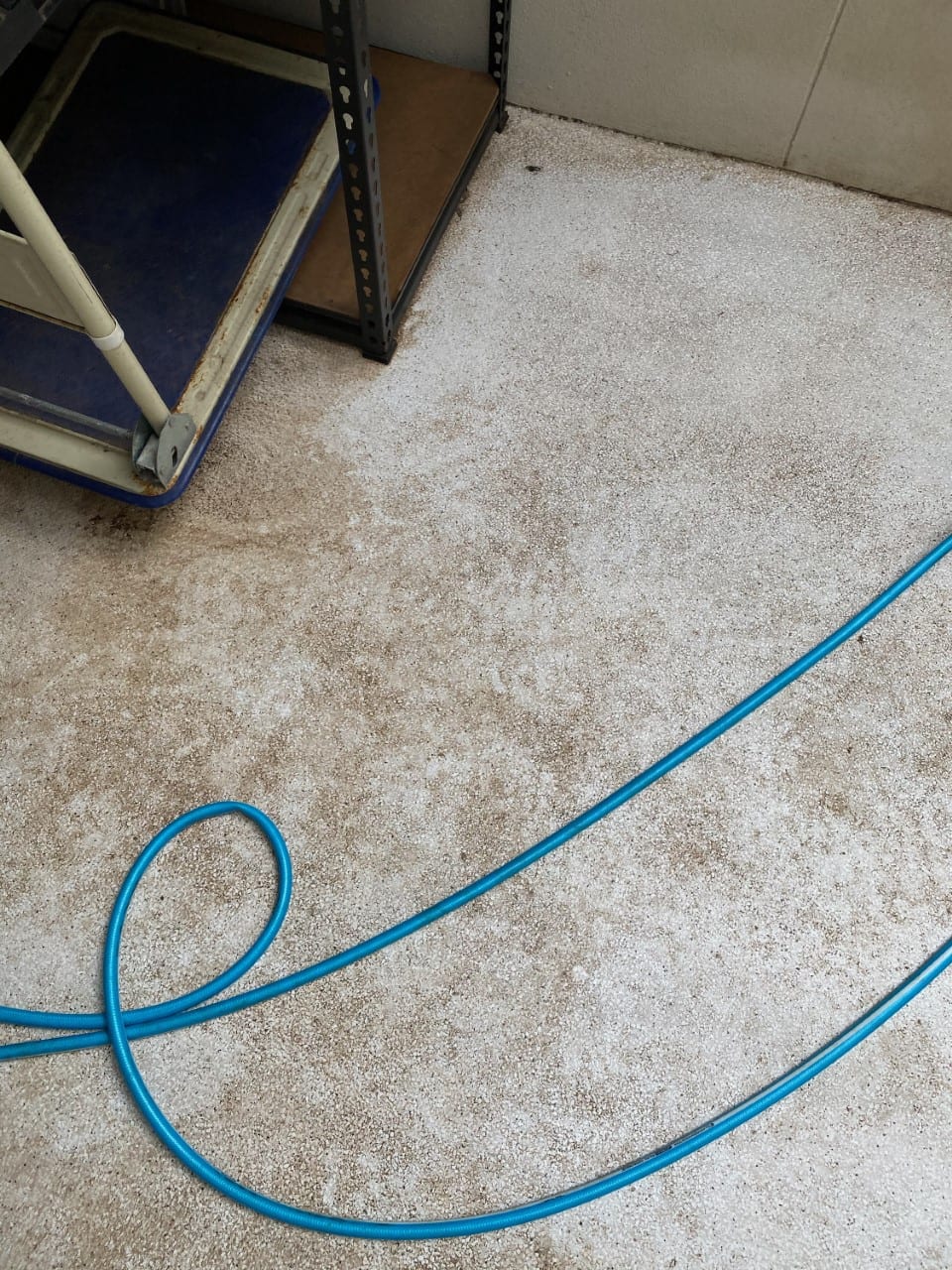
Image showing a flake floor with insufficient topcoat.
Well, I guess it depends on who is exposed to the risk. The installers are able to wear organic vapour masks and can
reduce their risk using PPE. The homeowner is unlikely to wear organic vapour masks for the duration of the solvent evaporation, so they
are the ones stuck with the pungent odour and risks from breathing VOCs. It is worth noting that different VOC's have different rates of
evaporation, so some VOC's will evaporate very quickly (like acetone) and others will take days to evaporate. Different solvents also
carry different risks.
There are no evaporative solvents with the Ezypoly example provided above.
https://www.realworldepoxies.com/solutions/residential-projects/resin-vinyl/
https://www.realworldepoxies.com/media/website_pages/advice/resin-vinyl-installation-guide.pdf
https://www.realworldepoxies.com/epoxy-flake-flooring/
https://www.realworldepoxies.com/advice/know-how/all-you-need-to-know-about-flake-flooring/
Get our 20-page resin flooring guide for specifiers and floor owners here
_800x271a.png)